Monday, 23 January 2012

Pioneer of Modernism workshop 11.04.2012.


http://county.durham.gov.uk/sites/dli/SiteCollectionDocuments/DLI%20Half-term%20and%20Easter%20Workshops%20February-March%202012.pdf


I will need to prepare for this! The preview was good. Interesting talk from curator giving insight into what the exhibition set out to explore - mainly the 2D work of the formal abstract years of Stephenson's art. Some of his later paintings are more in line with my abstract elements of my work. However experimenting with these more tight forms may well inform my practice and help me understand why I create the forms I do. 


Saturday, 21 January 2012

Creating more paths - floor and wall pieces.


 It came from the wall.

And take to the floor.

 Shrouded 1 .
 All that's left I and II.


 Spreading wavelengths.
Centred Trail.


    After dismantling my sculpture piece, Blown onto a new path , created for the White Room critique yesterday, I took the opportunity to use the empty space to further explore each piece of my "landscaped"  hessian. I wanted to consider the effects achieved by placing the shaped material on the wall and the floor - individually and jointly displayed. 
    All the newly created works didn't have as much depth and impression of fleeting movement as the original composite sculpture, where the hanging of the separate pieces on different planes and at varying heights gave it a full three dimensional quality, suggesting it was the result of many more objects and people having passed by and it being subjected to a bigger range of environmental conditions and changes. Some of the individual pieces did exist well on their own and presented as works in relief. With the longer lengths of hessian I was able to form some interesting pathways on the floor and the walls. The smaller pieces, including the stiffened coffee bags, appeared as vessels blown or forced in a particular direction. 

Wednesday, 18 January 2012

White Room. Hessian Hanging Sculpture.


This is a three dimensional piece of work made from various weaves of Hessian - new and found. It consists of various separate pieces hung from above with fishing line, occupying approximately half the space available in the White Room in the Sculpture Department at Ashburne House, University of Sunderland. This work emerges from the initial aim of creating a physical expression of movement and the imprints of trails it leaves behind in it's wake. Some of the appearance of the forms are reminiscent of Turner prize nominee Karla Black's recent installation work but the intent is more suited to the tonal "soft sculpture" realised by Eva Hesse. 

Each piece of material was prepared prior to hanging, shaped by being soaked in wallpaper paste and left to dry moulded around a variety of items found around the home and studio. Before construction I had no set room/floor plan. I worked with the fabric to position the forms, hanging each piece where I assessed it was best placed in relation to the others,referencing my own memories and encounters of how movement effects and reacts with objects and different environments. Following my desire to create something new but still reflective of known events,experiences, sensations and everyday objects .

The forms created are largely abstract with some figurative references, in particular shapes found in the landscape.

I chose hessian, as after trialling other materials, when saturated with glue, it provided me with the most lasting stiff forms along the length of the fabric. Also, I could access a variety of different sized weave, which comes in a small tonal range. This choice of materials and the tones of brown give the piece a natural feel, there are few hard edges as it is dominated by sweeping curves. The inclusion and manipulation of "found" coffee sacks has opened up the suggestion  that the sculpture has had a former life or journey or trail. I do like this idea, which I hadn't considered as important before. It widens it's appeal and makes me think I should try working with a greater range of fabric, whilst still using the same processes I continue to develop. This may help me decide whether how I deal with and react to the material I'm using is more important than the original subject matter,

This evolution I believe remains a sculpture rather than an installation, as one can view its entire form from a distance and although it can be seen from all around the "edges", the viewer cannot get completely involved with it, travel through it, experience being within it. Maybe next step is to make an installation, using my forms, to consider the space of an entire room. Think about making a work based  just along the floor or up near the ceiling, using more obvious material (e.g. twine) to hang sections.


I can see this sculptural piece in other white cube gallery settings but may need to consider other places / situations to display this and any installation which further develops. 


Tuesday, 17 January 2012

White Room preview


Spent all  afternoon installing this sculpture in White Room for critique tomorrow. All the separate pieces were pre-prepared, glued and moulded around a variety of items from around the house and studio. This is a progression from original Hessian work "What's left behind". This time  I used a variety of types / sources of  Hessian, including coffee sacks given to me by my local green waste collectors - "Rotters" - a left over from their coffee fuelled car exploits.Using the scrim was a revelation.

Monday, 16 January 2012

Black and white.


Pastel on acrylic painted black board (122x80cm)

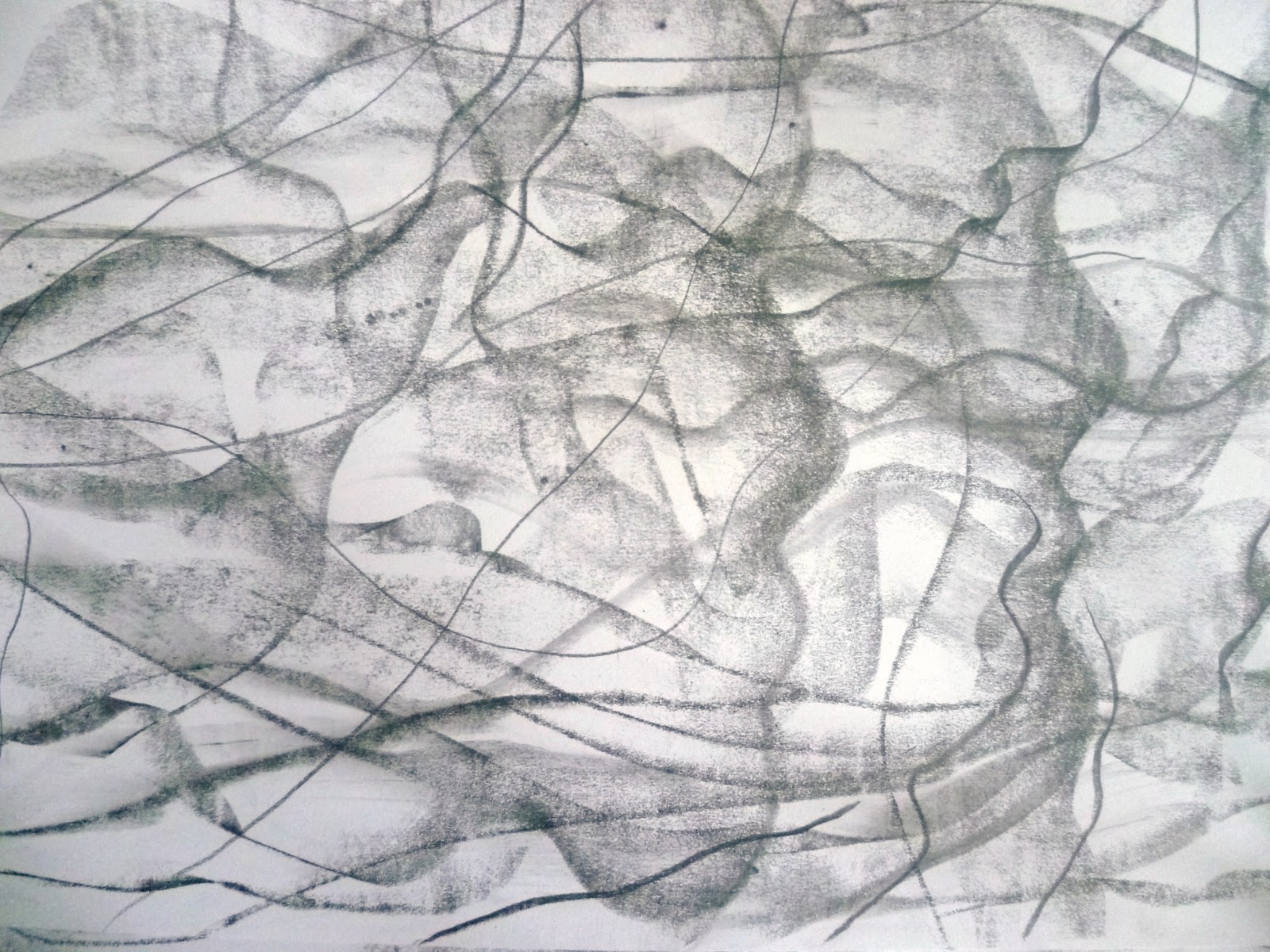
These black and white drawings have more impact and depth than the coloured abstracted versions. The colour limited palette enables the viewer to concentrate on the shape,density and direction of mark. Looking further at work of abstract expressionists and blackboard paintings/drawings of Tacita Dean.

This inspires me to look at producing some black and white digital photographs of my Hessian sculpture, aiming to produce a body of images to help me decide whether to pursue the tonal route


Monday, 9 January 2012


Pastel on acrylic painted black board (122x80cm)

A series of drawings using colours taken from pastel portraits. I have applied layer upon layer of paint and pastel in an attempt to create the effect that multiple trails have been made over time. The resulting pieces have a temporary quality which does promote idea that more tracks could be added to the compositions. The wide range of colours used although selected from an original source does appear on examination rather indiscriminate.

Monday, 5 December 2011

Build up colour from monotone or revert?


White/black pastel - scratches on acrylic painted black board (122x80cm)

Abstacting from portraits again in an attempt to produce a series of drawings - debating whether to follow a colour or tonal path. Layering (reapplying black acrylic paint is helping to produce a type of depth in the drawings I've not encountered before. I will continue to add to - as well as pursure 3D hessian structures which are fast developing into installation.

Saturday, 26 November 2011

White Room 23.11.11. What's left behind?

What's Left Behind? 2011. Hessian, pva glue, wallpaper paste.

What's Left Behind? 2011. Hessian, pva glue, wallpaper paste.

What's Left Behind? 2011. Hessian, pva glue, wallpaper paste.


What's Left Behind? 2011. Hessian, pva glue, wallpaper paste.


This critique was interesting and my work create quite a lively debate. I moulded the hessian soaked in wallpaper paste around various household items - stool, step ladder, bucket- to make the different forms.Suspended by fishing line, I then exhibited them together but not in their original orientation, which I think helped remove them from their practical application. My idea of attempting to show something had past by and left a trail, a set of imprints,  worked. The shapes are easier to interpret without using an extensive range of colours. A departure from colour. The direction of the forms produced also suggests a line of movement.

Monday, 21 November 2011

Studio Floor Tracks

Sanded trails. 2011. Paint dust on studio floor.

Sanded trails 1. 2011. Paint dust on studio floor.

Sanded trails2. 2011. Paint dust on studio floor.

Sanded trails 3. 2011. Paint dust on studio floor.

After sanding black painted plywood boards I shook the resulting dust onto the studio floor I made these works to emphasise the temporary and spontaneous nature of many tracks which anyone could encounter in the world, inside or outdoors. I then took this sanded dust and moved it across a piece of A1 cartridge paper and created a series of images with the intention of of making a video of these shifting sands. The initial results are promising but further editing of timings/ transitions could improve the effects significantly. Add sound?


Sanded 1. - draft 1


Draping one of my previous steel, wire, wood sculptures with pva glue soaked sheet in an attempt to create a skin, a remnant of something that once was there but has moved on. However, just didn't dry outside in the garden -wrong time of year! Not pleased with results- they look like poorly realised damp ghosts! I need to adapt method - try different "setting" agent, maybe different fabric/material. I don't want the supporting structure to remain and be part of the finished work - I'm not aiming purely to wrap things - like Christo - what's important is the imprint, the suggestion of of the shape which existed before. And getting to grips with the materials!


Sheeting/glue over steel/wire frame.

Sheeting/glue over steel/wire frame.

Sheeting/glue over steel/wire frame.


Tuesday, 8 November 2011

Layering gestural marks. Pastels mixed with paint.


Revisiting Headlines, pastel on canvas this time - attempt to develop -use colours and fragment lines and shapes to emphasise movement. Not totally convinced pastels work applied to canvas (primed with blackboard acrylic paint) The composition remains engaging but the range of colours used could be more considered perhaps restricted.

Headlines 1. Pastel on canvas.(122x80cm)

Black painted plywood ( 122x80cm  ) marks made with sandpaper , nails, black and white pastel. The movement created with the gestural marks I have applied work fairly well but I was looking to produce work with more prominent features. The black and white does work but the impact is more subtle. 


Adding soft pastels, colour range taken from original Headlines piece. Finish still not working, however shapes created by a mixture of hard cut lines and smudged areas do convey a movement of layers.

Reapply sweeps of black paint over pastel with large brush/cloth, then placed more pastel on top, in gaps made by the black  paint brush strokes,. The motion is still there - layers working- create more? Composition in landscape layout not achieving desired effect - try portrait orientation - make a series or sequence of pieces.

Sunday, 23 October 2011

The Shortest path.

Short cut, (ink, earth, ribbon, lining paper,) 2011.


In an attempt to create a "Desire Path" - a short route through a drawing of gestural marks made along a path in my garden on 8th October 2011. An interesting sculptural piece that has a temporary quality. The shape is not permanent, it has the ability to shift to provide a variety of different forms and positions.Many of my recent works have a temporary existence and quality. Maybe I should exploit this further.

Which path to take? (A1) Gummed tape on paper.